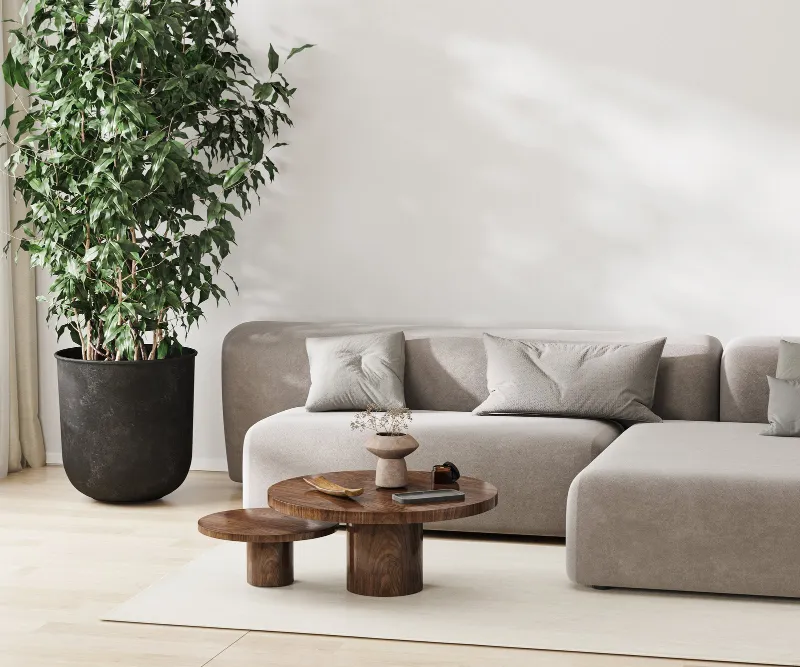
River slate
Blue-grey and silver with soft white movement, like the water on a cloudy morning.
Think of the river at dusk, bronze on the surface and slate underneath, poured into your living room. Each metallic floor is shaped by hand and settles into a pattern of its own.
Living next to the Colorado River, you see a lot of moving color. The water shifts from green to slate blue to bronze through the day, and the hills behind Laughlin go gold at sunset. A metallic epoxy floor captures some of that movement indoors.
It is the most artistic coating we install. Instead of throwing flake or rolling a solid color, we pour resin loaded with fine metallic pigment and work it with rollers, trowels and brushes. The pigments drift, swirl and pool as the resin levels, and the result has real depth. This page explains how it is done, where it works best and what to think about before choosing it.
Metallic pigments are tiny flakes of mica coated with metal oxides. Suspended in clear epoxy, they catch and reflect light from slightly different depths, which creates the shimmer and the three-dimensional effect.
The pattern is made by the installer and finished by the resin. After pouring, we move the material with tools and sometimes a little solvent spray to open up cells and veins. As the resin self-levels over the following minutes, the pigments settle into their final positions. That last bit of natural movement is why no two floors match, even when they are poured with the same colors.
A tinted base coat underneath controls how bright or deep the final floor looks.
Any color can be used. These combinations work especially well in homes and businesses around the river.
Blue-grey and silver with soft white movement, like the water on a cloudy morning.
Copper, bronze and a touch of gold, warm and glowing in evening light.
Champagne and pearl white, bright and airy in smaller rooms.
Charcoal and pewter with silver veining, bold and modern.
We make sample boards in your chosen colors before the job, so you can see them in your own rooms and lighting.
Metallic floors shine where they can be seen and enjoyed, and where traffic is moderate.
In a working garage or mudroom, flake is more practical. Metallic is for rooms where the floor is part of the design.
We talk through colors, movement and finish, and look at photos of floors you like.
We make boards in your chosen palette so you can approve the look.
Metallic shows every dip, so the slab is ground flat and patched carefully.
A primer seals the slab and a tinted base sets the background.
Shimmer-loaded resin goes down and the crew shapes it from one wall to the other without stopping.
A UV-stable urethane or polyaspartic protects the design.
Metallic floors are stunning, but they are not right for every space. Here is a fair comparison.
| Strengths | Things to plan for | |
|---|---|---|
| Look | Unique, deep, reflective | Pattern cannot be exactly repeated |
| Cleaning | Seamless and quick to mop | Gloss shows dust and footprints sooner |
| Wear | Protected by a hard topcoat | Sand underfoot can dull gloss over time |
| Sunlight | Glows in natural light | Needs a UV-stable topcoat near windows |
| Repair | Topcoat can be renewed | Damage to the design is hard to blend |
If you want the look in a busier space, a satin topcoat hides wear better. For high-traffic utility areas, decorative flake is the easier choice.
Metallic resin is sensitive to temperature. In a warm room it sets quickly, which gives less time to create the pattern. In a cool room it moves slowly and can look flat. We ask that the air conditioning run at a steady setting for a day before, during and after the pour, and we schedule summer jobs for the cooler part of the day.
Many homes here have big windows facing the river or the mountains. Strong sun through glass can slowly shift the color of epoxy that is not protected, so every metallic floor we install near windows gets a UV-stable topcoat.
Metallic is the least forgiving system we install. The whole room has to be poured in one go, materials must be mixed precisely, and the installer needs a practiced hand to create movement without obvious tool marks. Seams between batches, roller lines and dust specks are permanent once the resin sets. Ask any installer to show you sample boards and finished floors before you commit.
You have a lot of say in how the floor looks. Some people want tight, marble-like veins. Others prefer broad, soft clouds or a lava-like flow. We can lead movement toward a window, along a hallway or around a feature such as a fireplace or a bar. What we cannot do is control every detail, because the resin always has the last word. That bit of unpredictability is part of what makes the floor special.
High gloss shows off the depth of a metallic floor best, and it is the most popular choice in living rooms and showrooms. It also shows footprints, pet nose prints and dust sooner. Satin softens the reflection a little but is far more forgiving in everyday life. Some clients choose gloss for a formal room and satin for a family room in the same house.
Dust mop often, because sand is the main thing that dulls a glossy floor. Damp mop with a pH-neutral cleaner. Use felt pads under furniture and mats at exterior doors, especially those leading to the patio or pool. Avoid wax, oil soaps and harsh chemicals. Years from now, the clear topcoat can be lightly sanded and recoated to restore the shine without touching the design.
Metallic floors cost more than solid or flake systems because they use more layers, more material and more skilled labor. The size and shape of the room, how much flattening the slab needs, the number of colors and the topcoat choice all affect the price. We give a firm written quote after seeing the space and agreeing on the design.
For salons, boutiques, tasting rooms and showrooms, a metallic floor can be a signature part of the space. We use a tougher commercial topcoat and recommend entrance matting to catch grit from the parking lot. Work can be scheduled over a closed day or two, and we plan the pour so the room can reopen as quickly as the cure allows. See our commercial flooring page for more.
Lighting changes how a metallic floor looks more than people expect. Daylight from big windows brings out depth and movement. Warm interior bulbs deepen copper and bronze palettes, while cool LEDs make silver and pewter look crisp. Downlights can create bright spots in a high-gloss finish. We talk through your lighting during the design visit so the palette works at night as well as during the day.
We can match the palette and the general character, and you approve boards before we start. The fine detail always forms on its own, so an exact copy is not possible.
Gloss metallic is smooth. A fine texture can be added to the topcoat where slipping is a concern, such as near exterior doors.
The topcoat protects the design, but grit and dragged furniture can scratch it. Mats and felt pads go a long way.
Usually several days from grinding to the final topcoat, plus cure time before furniture goes back.
For a display garage, yes. For a garage that sees boats, trailers and sand, flake is more practical.
Not with a UV-stable topcoat, which we use wherever sunlight reaches the floor.
Usually not, though some people prefer to be out on the day of the pour. We contain the area and ventilate as needed.
Usually. The system is switched off for the install and eased back on over several days once the resin has cured.
Tell us about the room and the look you like. We will visit, make sample boards in your palette and give you a written quote.
Prefer to talk? (928) 555-0147